Why Is My Dog Not Learning? The Real Science Behind Dog Behavior
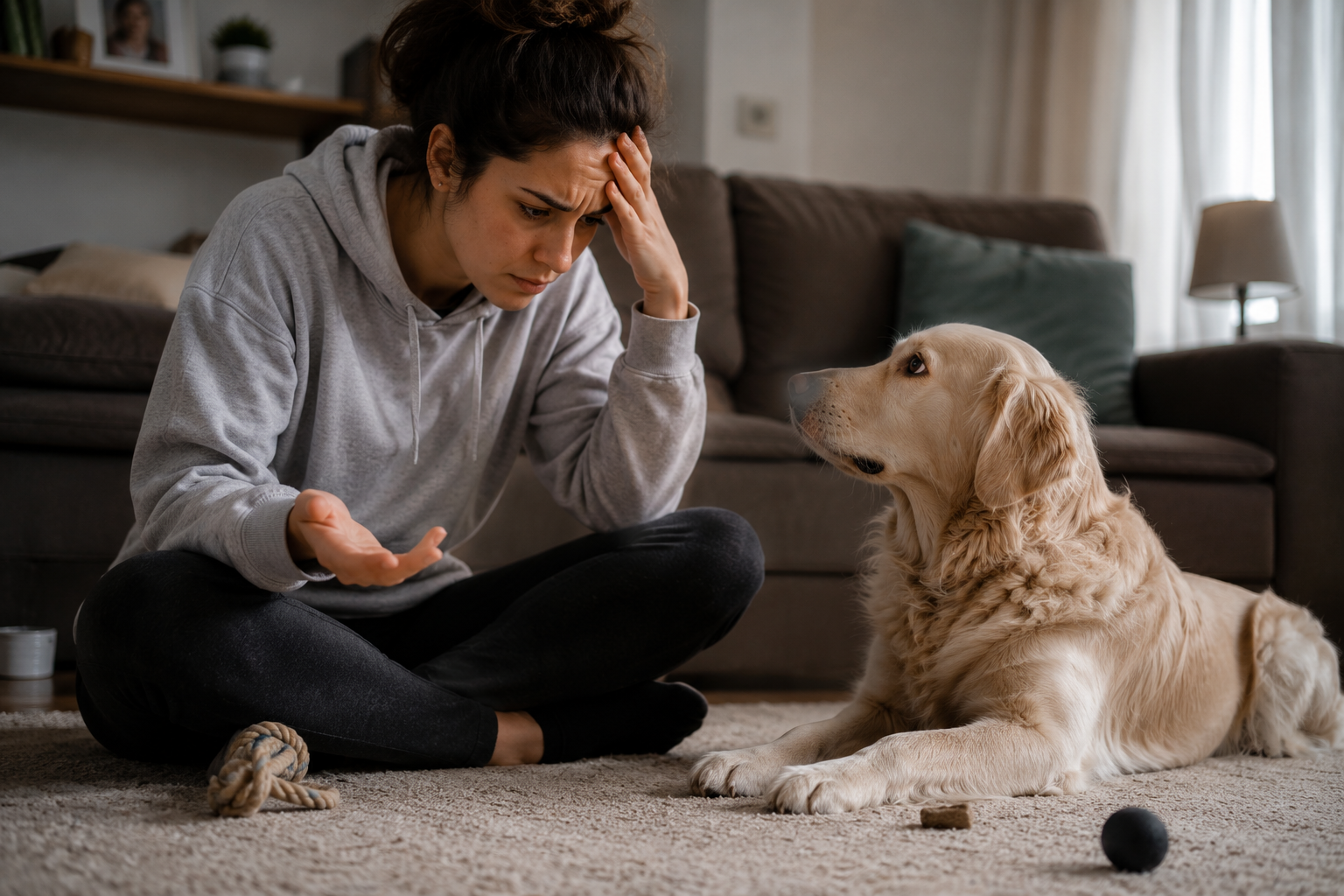
Rachel had been trying to potty train her 3-month-old Border Collie, Finn, for four weeks with zero consistent results. Border Collies are one of the smartest breeds on earth — yet Finn kept peeing inside despite a schedule, treats, and a crate. Rachel was exhausted and starting to question whether she was simply a bad dog trainer.
A trainer watched one session and spotted three problems immediately: Rachel was rewarding Finn 8–10 seconds after he finished going outside; she was using regular kibble as a “treat” that held no special value; and every time she found an accident indoors, she said “no” firmly — which Finn was associating with Rachel’s presence near cleaning supplies, not with the act of eliminating inside.
Three changes: high-value treats, a 2-second reward window, and completely silent indoor cleanup. Finn had his first accident-free week within five days. The same dog. The same owner. A completely different result — because the method finally matched how Finn’s brain actually learns.
Why Your Dog Is Not Learning: The 6 Most Common Real Reasons
When puppy potty training isn’t working — or house training a dog stalls after weeks of effort — the problem almost always falls into one of these six categories. Identifying which one applies to your dog is faster than trying every method until something sticks.
Reward Timing Is Off
The dog training learning window is 1–3 seconds. A treat or praise that arrives 5–10 seconds after the correct behavior cannot form the behavioral connection. This single issue explains the majority of cases where puppy training isn’t working despite a consistent schedule and good treats.
Low-Value Rewards
Dry kibble or familiar treats compete poorly with distractions and existing habits. Dog training not working often comes down to: the reward isn’t rewarding enough. High-value treats — chicken, cheese, freeze-dried liver — activate a much stronger dopamine response in the dog’s brain.
Inconsistent Puppy Training Schedule
Dogs build habits through dense repetition of the same stimulus-response-outcome pattern. An inconsistent puppy training schedule — perfect during the week, relaxed on weekends — breaks the habit loop before it can solidify. Consistency beats intensity every time.
Stress or Anxiety Blocking Learning
A stressed dog literally cannot learn efficiently. Cortisol — the stress hormone released during punishment or anxiety — directly impairs memory formation in the hippocampus. If your dog is anxious during training, the biology is working against you regardless of method.
Wrong Association Being Formed
Your dog might be learning — just not what you intended. Punishment near accidents teaches dogs to hide when they need to go, not where to go. The wrong association is forming, not no association. This is why dogs trained with punishment often have more indoor accidents over time, not fewer.
Too Much Unsupervised Indoor Freedom
When dog training isn’t working, giving more freedom to “figure it out” accelerates the problem. Unsupervised time means missed signals, undetected accidents building scent history, and the incorrect behavior reinforcing itself every time it goes uninterrupted.
Our 7-Day Potty Training Program applies behavioral science directly to puppy potty training and house training — with a clear daily plan and no guesswork.
✅ Science-backed · All breeds · Instant access
The Real Science Behind Dog Behavior: How Dogs Actually Learn
Understanding how dogs learn is the foundation of effective dog training. Modern canine behavioral science has largely moved past dominance theory — what actually drives dog learning is two core mechanisms that operate simultaneously during every training session.
Mechanism 1: Classical Conditioning (Association Learning)
Your dog’s brain constantly pairs stimuli. The leash appears — excitement. You pick up keys — anxiety in separation-prone dogs. You say “go potty” calmly before every outdoor trip — eventually the phrase itself triggers the pre-elimination urge. This is classical conditioning: automatic, emotional, and always active whether you’re managing it deliberately or not.
The critical danger: negative associations form just as easily as positive ones. Every tense interaction near a puppy accident, every raised voice during cleanup, every frustrated sigh is classically conditioning your dog — just not toward the behavior you want.
Mechanism 2: Operant Conditioning (Consequence Learning)
Dogs repeat behaviors that produce good outcomes and reduce behaviors that produce neutral or bad ones. Positive reinforcement — adding something the dog wants immediately after a correct behavior — is the most reliable and fast-acting operant tool available. This is the engine behind all effective puppy potty training and house training methods.
🎬 Watch our full breakdown of how dog behavior science applies directly to potty training and house training:
What Actually Works: Applying Dog Behavior Science to Potty Training Practical Steps
Behavioral science is only useful when it translates into specific, repeatable daily actions. Here is how to apply the science directly to puppy potty training, stopping your dog from peeing in the house, and house training a dog at any age:
Keep high-value treats in your pocket before stepping outside. The moment your dog finishes going in the correct spot: treat plus genuine enthusiastic praise immediately. This is the core operant loop that teaches where to go — and timing is the most critical variable.
Say “go potty” in the same calm tone every time you bring your dog to their designated spot. Over 7–14 days of consistent pairing, this phrase becomes a conditioned trigger — your dog begins associating the phrase with the act of eliminating, which accelerates the urge when they hear it.
Silent, calm cleanup of every indoor puppy accident prevents the formation of fear associations that impair all further learning. Your dog’s learning capacity is directly linked to their stress level — lower cortisol means faster habit formation.
The reward must activate a strong dopamine response. Small pieces of cooked chicken, cheese, or freeze-dried liver create the neurochemical signal that embeds the correct behavior. Familiar kibble creates a weak response. Match reward intensity to behavior importance.
Out after waking, after meals, after play, and before bed — every day, same structure. Behavioral habits in dogs form through repetition density. A slightly imperfect method applied with perfect consistency will outperform the best method applied variably.
Every unsupervised accident reinforces the wrong behavior; every prevented accident creates an opportunity to reinforce the right one. Use a crate, leash, or baby gates to manage the environment until at least 2 consecutive weeks without indoor accidents.
How to Stop Your Dog from Peeing in the House: Science-Based Fixes
Stopping indoor accidents requires addressing both behavioral and environmental factors at the same time. The science-based approach works on three levels simultaneously:
| Training Element | Behavioral Science Behind It | Practical Application |
|---|---|---|
| Scheduled outdoor trips | Creates predictable body clock and dense learning opportunities | Every 2 hours for puppies plus after all behavioral triggers |
| Immediate high-value reward | Dopamine reinforcement of correct elimination location | Treat plus praise within 3 seconds of finishing outdoors |
| Consistent cue word | Classical conditioning — pairs phrase with elimination act | Same word, same calm tone, every trip without exception |
| Enzymatic cleaner | Eliminates scent trigger that classically conditions return to spot | Clean every accident twice — scent must be fully gone |
| Silent indoor cleanup | Prevents fear conditioning that impairs all future learning | No reaction, no eye contact — clean and move on |
| Crate or active supervision | Prevents reinforcement of incorrect behavior through repetition | No unsupervised roaming until 2 weeks accident-free |
Indoor Potty Training for Small Dogs: Same Science, Adjusted Application
The behavioral science principles behind indoor potty training for small dogs are identical — only the target location changes. A grass pad or absorbent tray becomes the designated spot; the same cue word, same immediate reward, and same emotional neutrality apply without modification.
Potty Training an 8-Month-Old Dog: Applying Science to Break Existing Habits
When potty training an 8-month-old dog with established indoor habits, behavioral science adds one additional concept: extinction — the process of eliminating a previously reinforced behavior. Extinction takes longer and more consistency than building a new behavior from scratch, because old neural pathways must weaken while new ones form.
The approach: extinguish the indoor habit by removing all scent triggers and eliminating unsupervised opportunities, while simultaneously building the outdoor habit with dense positive reinforcement. Both must happen in parallel — extinction alone leaves a behavioral gap that often fills with an adjacent unwanted behavior.
Golden Retriever Potty Training: Why This Breed Learns Fastest with Positive Methods
Golden Retrievers were selectively bred over generations to respond to human cues, work cooperatively with handlers, and find human approval intrinsically rewarding. From a behavioral science perspective, their social reward pathways are highly active — your praise and excitement can function nearly as powerfully as food for a well-socialized Golden.
This also means classical conditioning builds faster with Goldens. Most Golden owners see a reliable cue word response within 5–7 days of consistent use, compared to 10–14 days for many other breeds. The science works for all dogs — it just works particularly fast with Goldens.
Frequently Asked Questions
The 7-Day Potty Training Program applies behavioral science principles in one complete daily plan — reward timing, cue words, schedule, supervision, and everything else your dog needs to actually learn.
🎯 Get the Full 7-Day Program Now
✅ Instant access · All breeds · Puppies to adults · Science-backed