My Golden Retriever Kept Having Accidents Indoors — Here’s What Finally Worked
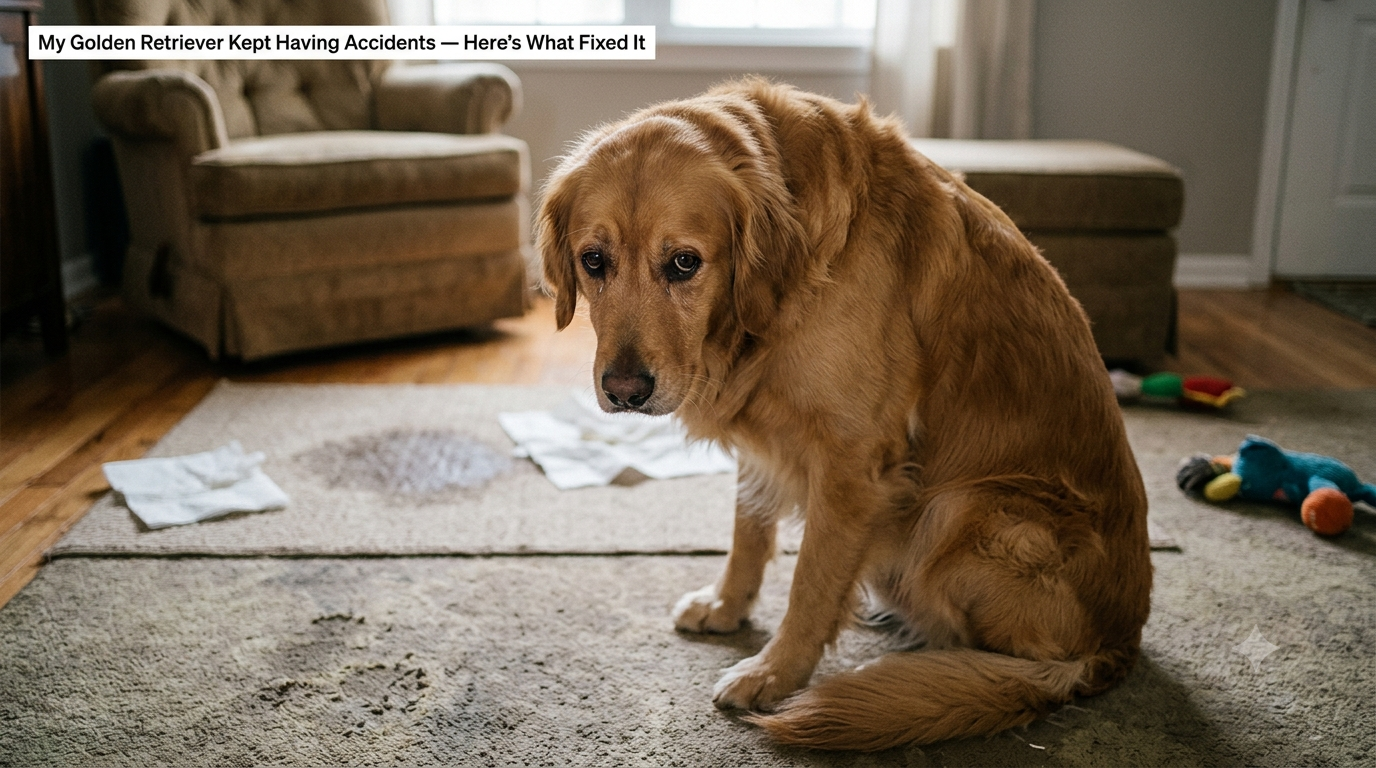
When we brought Buddy home at eight weeks old, I pictured lazy Sunday mornings and easy walks around the block. What I got instead was three weeks of scrubbing the same corner of the living room rug, over and over, until the smell wouldn’t fully come out no matter what I used.
Buddy treated the house like one giant bathroom — behind the couch, next to his water bowl, even on his own bed. I remember one morning specifically: I had just mopped the kitchen floor, turned around to grab my coffee, and turned back to find a puddle right in the spot I’d just cleaned. That was the morning I admitted what I was doing wasn’t working.
I’d tried everything — puppy pads scattered in every room “just in case,” constant hovering that left me exhausted by 10am, even rubbing his nose in an accident once on bad advice, which I regret. The real fix wasn’t a new product. It was switching to one consistent routine instead of scattered rules. By day 3 we saw a real difference. By day 7, Buddy was walking to the back door and sitting there instead of having an accident.
Why Golden Retrievers Keep Having Accidents Indoors
If your Golden Retriever is still having accidents weeks into training, it’s almost never about intelligence. The real culprits are usually one of these:
Reward Timing Is Off
Praise or treats given more than a few seconds after your dog finishes outside don’t connect properly to the behavior. The reward window is tiny — get it right and the habit forms fast.
Inconsistent Schedule
Feeding, water, and bathroom breaks happening at different times each day confuse a puppy’s internal clock and slow down house training significantly.
Too Much Freedom Too Soon
Full run of the house before a puppy has earned that trust means more hidden corners, more missed signals, and more accidents that go unnoticed.
Missed Body Language
Sniffing, circling, and whining are clear signals — but they’re easy to miss in a busy household unless you know exactly what to watch for.
Punishment-Based Corrections
Scolding or rubbing a dog’s nose in an accident teaches them to hide when they need to go — not where to go. This often makes accidents worse, not better.
Leftover Odor
Regular cleaners often leave a scent trail that pulls a dog right back to the same spot, even after it looks completely clean to you.
The exact step-by-step system that finally worked for Buddy is laid out in our free 7-day potty training guide.
🎯 Get the 7-Day Potty Training Program
✅ Works for all breeds · Puppies to adults · Instant access
What Finally Worked for Us Step by Step
Here’s the exact routine that turned things around — the same one we now walk thousands of Golden Retriever owners through.
We took Buddy out first thing in the morning, after every meal, after naps, after play, and right before bed — at the same times daily, down to the hour. His body learned to expect it, and accidents dropped almost immediately.
Instead of free roam of the house, we kept Buddy in one room with us using a baby gate, and used a crate when we couldn’t watch him directly. Fewer hidden corners meant far fewer accidents.
Praising and treating him the instant he finished outside — not after walking back inside — helped him connect the reward to the actual act of going outside.
Regular household cleaners weren’t enough. Once we treated every previous accident spot with an enzyme-based cleaner, Buddy stopped returning to those same areas entirely.
The moment we stopped scolding accidents and focused only on rewarding successes, Buddy became noticeably calmer — and, ironically, far more reliable.
How Long It Actually Took
We saw real improvement by day 3, and by day 7, accidents had essentially stopped. That lines up with how quickly a Golden Retriever puppy can build a new habit when the routine stays consistent every single day — which is exactly why our program is structured around 7 days instead of a vague “it takes time” approach.
| Training Element | Why It Matters | How to Apply It |
|---|---|---|
| Scheduled outdoor trips | Builds a predictable body clock | Every 1–2 hours for puppies, plus after meals, naps, and play |
| Immediate reward | Connects the treat to the correct behavior | Treat and praise within seconds of finishing outside |
| Consistent cue word | Speeds up the learned association | Same word, same calm tone, every single trip |
| Enzyme cleaner | Removes the scent trail that pulls dogs back | Clean every old spot thoroughly, more than once if needed |
| Calm indoor cleanup | Avoids teaching your dog to hide accidents | No scolding — clean quietly and move on |
| Supervision or crate | Prevents accidents from going unnoticed and repeating | No unsupervised roaming until 2 weeks accident-free |
🎬 Watch the full walkthrough of the exact routine that stopped Buddy’s accidents in 7 days:
A Note on Older Golden Retrievers and Sudden Accidents
If your Golden Retriever was already house trained and suddenly starts having accidents again, the cause is often different from a puppy still learning. A change in routine, a new stressor at home, or a medical issue like a urinary tract infection can all trigger sudden regressions.
Frequently Asked Questions
Follow the same day-by-day plan that worked for Buddy — no guesswork, no more ruined rugs.
✅ Instant access · All breeds · Puppies to adults