Puppy Potty Training Not Working? Check How Much Water Your Dog Drinks
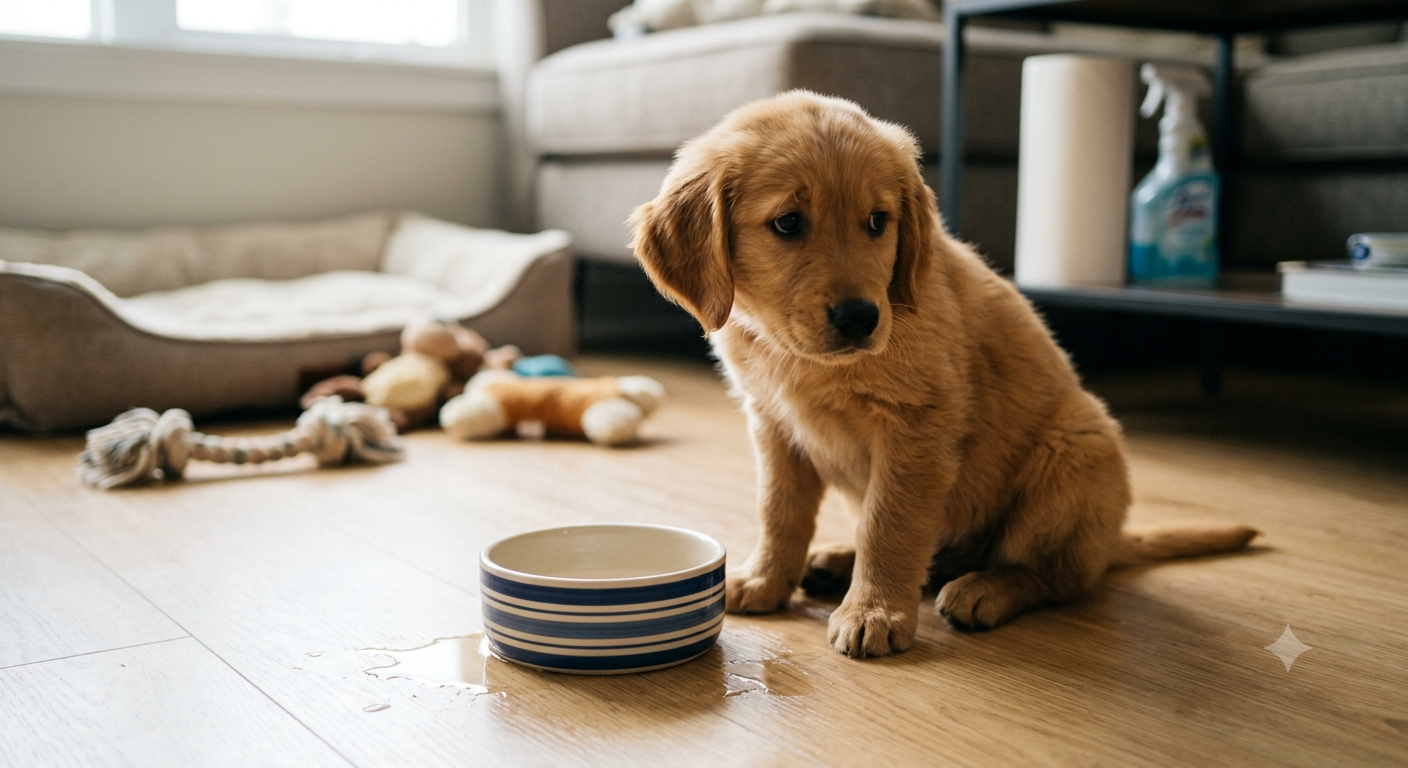
Tom was doing everything by the book. His 14-week-old Golden Retriever, Sunny, had a consistent schedule, a designated outdoor spot, and got a treat every time she went in the right place. But despite all of this, Sunny was still having 3–4 accidents a day — and most of them seemed to happen completely randomly, with no warning.
A trainer visited and spotted the problem within five minutes: Sunny had a large, constantly refilled water bowl that she could drink from any time she wanted. She’d been guzzling water in big sessions — especially after play — and her bladder would fill and overflow within 20–30 minutes. Tom’s hourly schedule simply couldn’t keep up.
The trainer suggested structured water access: scheduled drinking times aligned with outdoor trips, water removed 2 hours before bed, and monitoring Sunny’s drinking behavior so Tom could predict the need accurately. Within three days, the random midday accidents dropped from four to zero. “I never even thought about the water bowl,” Tom said. “I thought that was a completely separate issue from potty training.”
The Direct Link Between Water Intake and Potty Training Accidents
Most owners think of potty training as a behavioral challenge — about teaching the dog where to go. But before the behavior can be trained, the physiology has to be manageable. And water intake is the single most direct physiological factor affecting how often your puppy needs to eliminate.
This creates a specific pattern: your schedule says “go out every 90 minutes” but your dog just drank heavily after play — meaning they’ll need to go in 20 minutes. The schedule misses the trigger entirely. The accident happens not because training has failed, but because the schedule wasn’t responsive to what the dog just drank.
Signs That Water Intake Is Affecting Your Training
- Accidents seem random with no clear pattern
- Your dog goes outside successfully but then has an accident 20–30 minutes later inside
- Accidents cluster in the afternoon (often when dogs drink more after activity)
- Your dog drinks in large gulps after play, meals, or excitement
- You’re following the schedule perfectly but still seeing 3+ daily accidents
Our 7-Day Program includes water management guidelines alongside the full training schedule — so every variable is covered from day one.
✅ Works for all ages, breeds, and living situations
How Much Water Should a Puppy Actually Drink? Daily Guidelines
Understanding normal water intake helps you identify when your dog is drinking too much — which can indicate both a management issue and occasionally a medical one.
| Dog Size | Daily Water Guideline | Notes |
|---|---|---|
| Toy / Small breeds (under 10 lbs) | ½ to 1 cup per day | Increases significantly after play or in hot weather |
| Small breeds (10–20 lbs) | 1 to 2 cups per day | Monitor closely — small breeds can over-drink |
| Medium breeds (20–50 lbs) | 2 to 4 cups per day | Standard training schedule usually sufficient |
| Large breeds (50–80 lbs) | 4 to 6 cups per day | Golden Retrievers often at the higher end |
| Extra large breeds (80 lbs+) | 6 to 8+ cups per day | More bladder capacity balances higher intake |
How to Manage Water Intake During Potty Training Without Dehydrating Your Dog
Water management during potty training is not about restricting water — it’s about making intake predictable so your schedule can account for it accurately. Here’s the exact approach:
Offer water at consistent times: after waking, after meals, after play, and at mid-afternoon. This makes drinking predictable — and means you know that 20–30 minutes after each water session, a potty trip is needed.
Add this as a non-negotiable trigger trip: anytime your dog drinks — especially a large amount — set a 20-minute timer. This single habit eliminates most post-drinking indoor accidents within days.
This is the single most effective change for eliminating overnight accidents. A puppy that hasn’t had water for 2 hours before sleep has a significantly reduced bladder volume — often enough to sleep through the night weeks earlier than expected.
Dogs that gulp large amounts in one sitting fill their bladder faster than dogs that drink small amounts frequently. If your dog is a “gulper,” shorter and more frequent water access reduces the spike-and-crash cycle that creates sudden urgent accidents.
During summer or after vigorous play, your dog needs more water — but needs more outdoor trips accordingly. Increase both water access and potty trip frequency on active days, rather than keeping the same schedule regardless of activity level.
🎬 Watch our video guide on managing water intake alongside your potty training schedule:
How to Potty Train Your Dog Quickly Once Water Is Under Control
Once you’ve made water intake predictable, your potty training schedule becomes dramatically more accurate. Combine structured water access with these core training elements for the fastest results:
| Training Element | Action | Timing |
|---|---|---|
| After waking | Outside immediately + water offered | First 2 minutes |
| After water session | Outside trip 20–30 min after drinking | Set timer immediately |
| After meals | Outside 15 min after eating (food + water consumed) | 15 min post-meal |
| After play | Water offered → outside trip 20 min later | Post-play every time |
| Before bed | Water removed 2 hours prior → final trip | Last trip of the night |
| Every outdoor success | Treat + praise within 3 seconds | Immediate — always |
How to Stop Your Dog from Peeing in the House: The Water Factor
If you’ve been struggling to stop indoor accidents despite a consistent schedule, water intake is often the missing variable. Here’s how to audit your current approach:
- Track drinking and accidents for 3 days — note when your dog drinks and when accidents happen. A 20–30 minute gap between drinking and accident is a clear indicator of the water-intake pattern.
- Check your bowl situation — large, constantly full bowls encourage big gulping sessions. A smaller bowl that you refill at structured times creates more predictable intake patterns.
- Eliminate the “free access” window overnight — water available through the night means your dog can drink at 2am and need to go at 2:30am without any trip scheduled. Remove overnight water for puppies under 6 months.
- Add post-drinking trips to your accident log — if accidents decrease when you add these trips, water management was your missing piece.
Indoor Potty Training for Small Dogs: Water Management Is Even More Critical
Small dogs have less bladder capacity — which means the time between drinking and needing to urinate is even shorter than in larger breeds. A toy breed that drinks 1/4 cup of water may need to go in as little as 15 minutes. For small dogs using indoor pads or grass trays, structured water access is arguably more important than the schedule itself.
The 7-Day Program includes water management, schedule timing, reward strategy, and everything else you need — in one complete daily plan.
🔒 All breeds · All ages · Instant access
Potty Training an 8-Month-Old Dog: Water Management Becomes More Flexible
By 8 months, most dogs have significantly better bladder control — the gap between drinking and needing to urinate extends to 45–60 minutes or more. However, dogs that have been drinking freely without structure for 8 months may have developed gulping habits that still cause sudden urgency despite their better physical control.
For 8-month-old dogs in retraining, the water management approach is the same but with slightly more relaxed timing — post-drinking trips can be scheduled at 30–45 minutes rather than 20 minutes. The overnight water restriction remains important until training is fully stable.
Golden Retriever Potty Training: Managing a High-Intake Breed
Golden Retrievers are known for enthusiastic water drinking — they tend to lap up large volumes quickly, especially after exercise. Combined with their large size and active nature, this makes water management particularly important for Golden owners during the training period.
The good news: Goldens also have proportionally larger bladders than small breeds, so the 20–30 minute window after drinking applies well. The key for Goldens is managing post-exercise drinking specifically — after a run or play session, a Golden may drink nearly a cup of water, which needs a potty trip factored in roughly 25 minutes later.
Frequently Asked Questions
The 7-Day Potty Training Program addresses water management, trigger trips, rewards, and supervision — so no variable gets missed and no accident gets explained away as “random.”
🎯 Get the Full 7-Day Program Now
✅ Instant access · All breeds · Puppies to adults