Your Dog Warns You Before Peeing Inside: 7 Signs You’re Missing
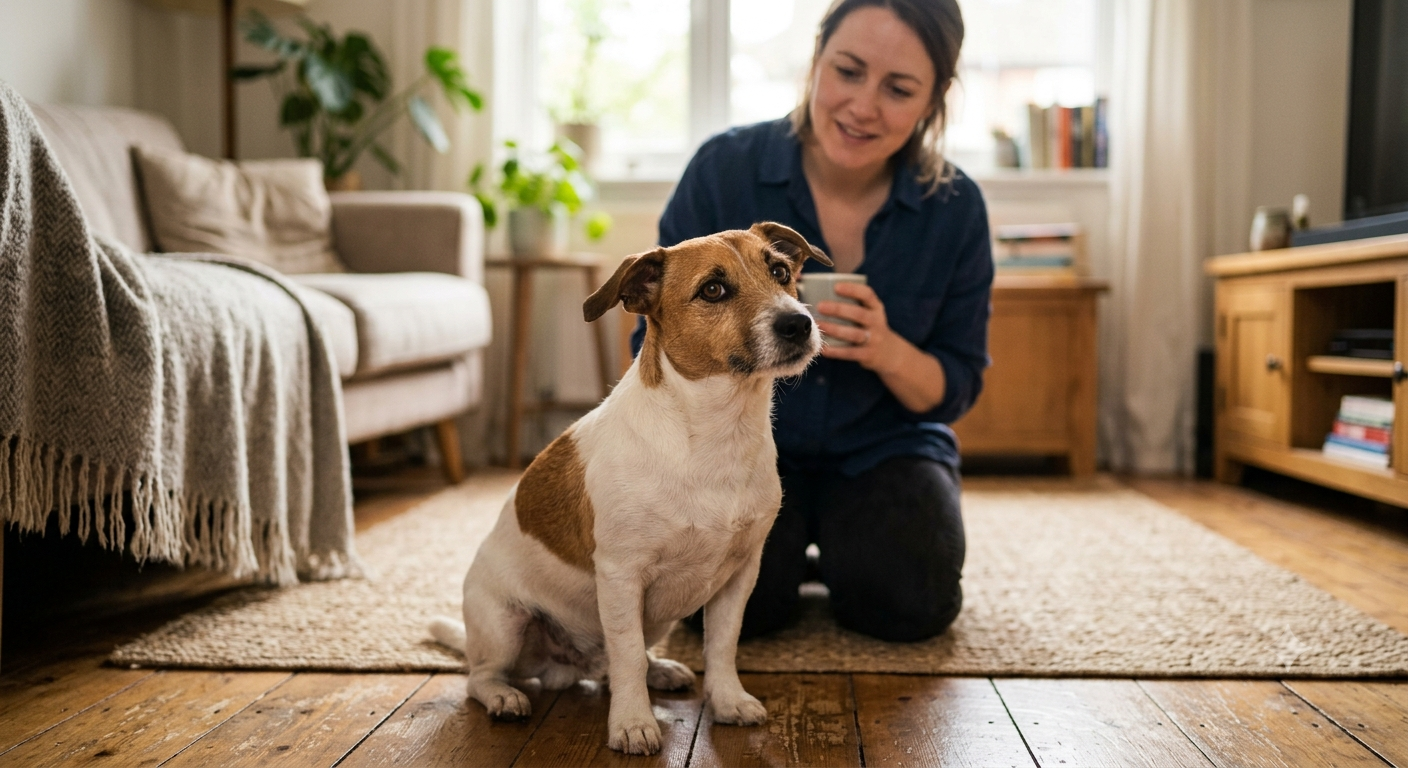
Hannah was convinced her 5-month-old Beagle, Biscuit, had no warning behaviors at all. “He just goes,” she told her trainer. “There’s no signal — he’s fine one second and peeing the next.” Frustrated, she started filming Biscuit during the day to capture an accident on camera and prove her point.
When she reviewed the footage that evening, she was stunned. Eighteen seconds before every single accident, Biscuit did the exact same thing: he stopped what he was doing, sniffed the floor in a tight circle three times, then looked up at her briefly before squatting. She’d been in the room every time — and had simply never registered it as a signal because it happened so fast and so quietly.
Once Hannah knew what to look for, she started catching the signal in real time. Within four days, Biscuit had zero accidents — not because his behavior changed, but because Hannah finally learned to see what he’d been telling her all along.
Why Most Owners Miss Their Dog’s Warning Signs
Dog warning signals before elimination are often subtle, brief, and easy to dismiss as random behavior — especially when you’re distracted, on your phone, or in another room. Most signals last only 5–15 seconds, which means there’s a very small window to notice and react.
Our complete program teaches you to recognize and respond to your dog’s signals — plus the full schedule and reward system that makes training stick.
✅ Works for puppies, adult dogs, and all breeds
The 7 Warning Signs Your Dog Gives Before an Accident Watch Closely
Not casual sniffing while walking around — this is sudden, focused sniffing directed at one specific spot on the floor, often in a tight pattern. This is the single most common pre-elimination signal across all breeds and ages.
Your dog turns in a small circle, sometimes two or three times, in the same location. This instinctive behavior — inherited from wild ancestors checking the area before eliminating — almost always precedes going within seconds.
This is the signal you’re actively training your dog to show — but many owners miss it the first several times it happens because they’re not yet expecting it. If your dog walks purposefully toward any door, even one they don’t usually use, treat it as urgent.
A dog that was calm and settled suddenly gets up, paces a few steps, lies back down, then gets up again within a minute. This restlessness pattern is a strong indicator of physical discomfort building from a full bladder.
Some dogs — particularly those bred for close human interaction, like Golden Retrievers — communicate need through direct, sustained eye contact rather than physical movement. If your dog is staring at you with unusual intensity, check in immediately.
A quiet whine, especially combined with any of the other signals on this list, is a clear urgency indicator. This is more common in dogs that have started learning to communicate but haven’t yet mastered going to the door reliably.
Mid-play, mid-chew, mid-anything — your dog suddenly stops what they’re doing completely. This interruption in behavior, even without obvious sniffing or circling, often indicates the onset of urgency that’s about to escalate quickly.
🎬 Watch our video breakdown of these 7 signals in real dogs — so you know exactly what to look for:
What to Do the Moment You Catch a Signal
Recognizing the signal is only half the equation — your response in that moment determines whether you prevent the accident or just watch it happen anyway. Here’s the correct sequence:
- Interrupt calmly — a soft, neutral sound like “outside?” or a light clap, not a loud or scary reaction
- Move immediately — guide or carry your dog (for small breeds) to the door without delay; every second counts once a signal appears
- Go straight to the designated spot — don’t stop for anything else on the way
- Reward enthusiastically if they finish outside — treat + praise within 3 seconds, every time
- If they don’t make it in time — no punishment, clean silently, and treat it as data: you caught the signal a few seconds too late, which tells you to react even faster next time
How to Stop Your Dog from Peeing in the House by Reading Signals
Most indoor accidents aren’t failures of training — they’re failures of observation. Building the habit of consistently watching for these 7 signals, especially during the first few weeks of training, dramatically reduces accidents even before your schedule and rewards have fully kicked in.
| Common Mistake | Why It Misses the Signal | Fix |
|---|---|---|
| Phone or screen distraction | Signals last only 5–15 seconds | Designate phone-free supervision windows during early training |
| Dog in another room | You can’t see circling or sniffing | Use baby gates to keep dog in your sightline |
| Assuming “they just went” | Multiple elimination needs can occur close together | Treat every signal as valid, regardless of recent trips |
| Slow reaction time | Hesitating to confirm the signal wastes critical seconds | React to the first sign of any of the 7 signals immediately |
How to Potty Train Your Dog Quickly Using Signal Recognition
Combining signal recognition with a structured schedule produces faster results than either approach alone. The schedule catches predictable timing-based needs; signal recognition catches everything the schedule misses — meals that were larger than usual, extra water, or simply natural variation in your dog’s body.
Indoor Potty Training for Small Dogs: Signals Happen Faster
Small breeds show these same 7 signals — but compressed into an even shorter window. A Chihuahua’s sniff-circle-squat sequence can complete in under 5 seconds, compared to 10–15 seconds for larger breeds. This makes constant visual supervision even more important for small dogs during the early training period.
- Keep small dogs within arm’s reach — a leash or tether indoors ensures you never miss a signal due to distance
- Watch for micro-versions of the signals — a quick head-down sniff or a brief pause in play counts just as much as a more obvious circling pattern
- React faster than you think necessary — with small dogs, treating any ambiguous behavior as a signal is safer than waiting for confirmation
Potty Training an 8-Month-Old Dog: Reinforcing Signal Communication
An 8-month-old dog that hasn’t been fully trained may not yet have learned that signaling actually works — meaning they might show subtler or less frequent signals because past attempts to communicate weren’t responded to consistently. Part of retraining at this age involves actively reinforcing every signal you notice, even small or ambiguous ones, to rebuild your dog’s confidence that signaling leads to a response.
Golden Retriever Potty Training: How This Breed Signals Differently
Golden Retrievers are highly communicative with their owners — often relying more heavily on eye contact and proximity-seeking behavior (signal #5) than the more universal sniff-and-circle pattern. A Golden that suddenly seeks you out, makes prolonged eye contact, or nudges your hand may be signaling just as clearly as a dog that’s circling near the door.
Because Goldens are so socially attuned, they also tend to develop reliable signaling faster than many breeds once their signals are consistently rewarded — often within 2–3 weeks of consistent response.
Frequently Asked Questions
The 7-Day Potty Training Program teaches you to recognize and respond to every signal your dog gives, combined with the full schedule and reward system for complete, fast results.
🎯 Get the Full 7-Day Program Now
✅ Instant access · All breeds · Puppies to adults