Potty Training a Small Dog Is Harder Than You Think — Here’s Why
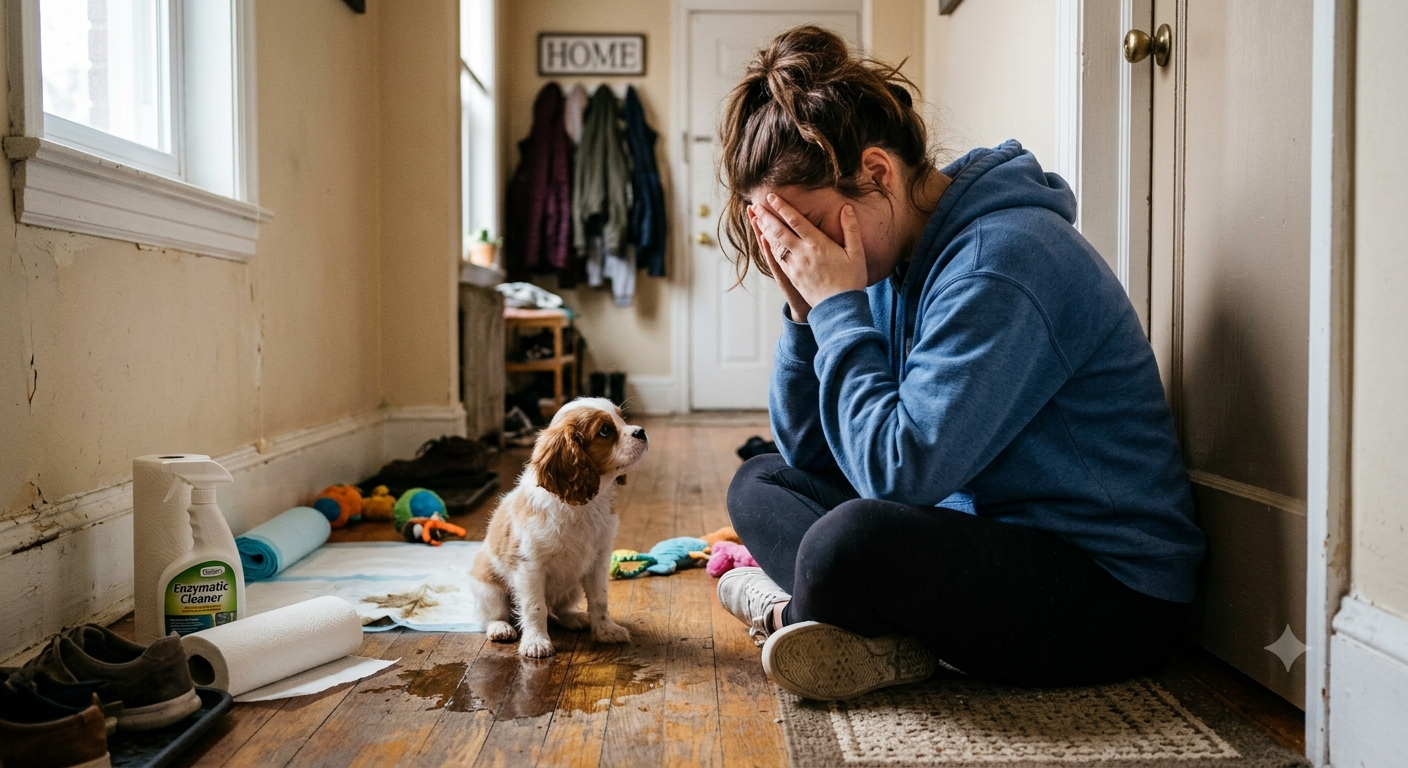
Lisa had owned large dogs her whole life — two Labradors, both trained within a few weeks. When she got her first small dog, a 10-week-old Chihuahua named Pico, she assumed the process would be even easier. How hard could it be with such a tiny dog?
Four months later, Pico was still having multiple accidents daily. He’d peed behind the sofa, under the bed, in the corner of every room — and always in spots Lisa hadn’t noticed until the smell set in. She’d tried pads, she’d tried a schedule, she’d tried taking him outside every hour. Nothing stuck.
The problem, she eventually discovered, was that she’d been applying large-dog logic to a small-dog body. Pico needed outdoor trips every 45 minutes — not every hour. His signals were tiny and fast — a quick sniff and squat that happened in seconds before she could react. And because he was small enough to hide in corners she couldn’t easily reach, his accidents were going undetected and uncleaned.
Once Lisa adjusted her schedule to 45-minute intervals, started keeping Pico on a leash indoors so he stayed visible, and treated every outdoor success like a major celebration — things changed within a week. “I trained two large dogs in my life and thought I knew what I was doing. Pico humbled me completely,” she said.
The Real Reasons Small Dogs Are Harder to Potty Train
Small dog potty training difficulties aren’t random — they have specific, consistent causes that apply across nearly all small breeds. Understanding them is the first step to solving them.
Smaller Bladder = Less Hold Time
A Chihuahua’s bladder is physically smaller than a Labrador’s. A 3-month small breed puppy may only hold it for 45–60 minutes, compared to 2–3 hours for a larger breed at the same age.
Faster Elimination Signals
Small dogs squat faster and for shorter durations than large dogs. The sniff-circle-squat sequence happens so quickly that owners often miss the signal entirely — and react only after the accident is done.
Accidents Happen in Hidden Spots
A small dog can fit behind sofas, under beds, and in corners that a larger dog couldn’t access. These spots stay wet and scent-marked for weeks because owners don’t find them until the smell is obvious.
Higher Weather Sensitivity
Small dogs feel cold, rain, and wind much more intensely than larger breeds. This causes them to rush outdoor trips without fully eliminating — or refuse to go outside at all in bad weather.
Small Dog Syndrome from Owners
Owners of small dogs are statistically more likely to excuse accidents, pick up the dog instead of redirecting, or skip discipline entirely because “it’s such a small mess.” These responses actively delay training.
More Indoor Time = More Opportunities
Small dogs spend more time indoors than larger breeds, have more unsupervised access to every room, and are carried rather than walked — all of which reduce training consistency.
Our complete potty training system includes specific small breed adjustments — timing, indoor options, and the exact reward strategy for tiny dogs with big personalities.
✅ Works for Chihuahuas, Maltese, Pomeranians & all small breeds
Indoor Potty Training for Small Dogs: The Adjusted Schedule Small Breed Specific
The standard potty training schedule — based on one hour per month of age — needs to be shortened for small breeds. Here’s the adjusted timing that works:
| Age | Standard Large Breed Interval | Small Breed Adjusted Interval | Daily Trips |
|---|---|---|---|
| 8–10 weeks | Every 1–2 hours | Every 30–45 minutes | 14–16 trips |
| 10–12 weeks | Every 2 hours | Every 60–75 minutes | 12–14 trips |
| 3–4 months | Every 3 hours | Every 90 minutes | 8–10 trips |
| 5–6 months | Every 4 hours | Every 2–3 hours | 6–8 trips |
| 8 months+ | Every 4–6 hours | Every 3–4 hours | 5–6 trips |
How to Potty Train Your Small Dog Quickly: The Step-by-Step Method
This is the single most impactful change for small breed training. A leash attached to you (or a tether to furniture nearby) means your dog can never sneak to a hidden corner unseen. You catch every signal before the accident happens.
Small dogs show pre-elimination signals just like large dogs — but faster and more subtly. Watch for: sudden intense sniffing, lowering of the backend, a quick circling motion, or simply losing interest in what they were doing. These all mean “right now.”
For bad weather, nighttime, or apartments, an artificial grass pad placed in one fixed location gives your small dog a reliable indoor option without creating a “anywhere is okay” habit. Use the same cue word here as you would outdoors.
Small dogs respond especially strongly to vocal enthusiasm. The moment your dog finishes in the right spot: high-pitched excited praise + tiny high-value treat within 3 seconds. Don’t underestimate the power of your voice for small breeds.
Get on your hands and knees and check every hidden corner, under every piece of furniture, and behind every door. Use a UV blacklight if needed — dried urine glows clearly. Every unmarked spot that’s been missed is pulling your dog back to that location.
Small dog owners frequently carry their dogs to the outdoor spot, removing the dog’s ability to learn the route and develop the habit of walking to the door. Always walk your dog to the spot — even if they’re tiny and it’s faster to carry them.
🎬 Watch our full video guide on potty training small dogs — including indoor pad setup and the exact small-breed schedule:
Indoor Potty Solutions for Small Dogs: Which Works Best?
Small dogs have more indoor potty options than larger breeds — and choosing the right one (and using it correctly) makes a significant difference in training speed.
| Option | Best For | Key Advantage | Common Mistake |
|---|---|---|---|
| 🌿 Artificial grass tray | Long-term indoor solution | Most natural feel, reusable, easy clean | Moving it around — keep it in ONE fixed spot |
| 📄 Absorbent pads | Early training stage | Disposable, attractant scent available | Using multiple pads in different rooms |
| 🏠 Indoor dog bathroom | Apartment dwellers | Contains mess, looks clean | Placing it too close to food or water |
| 🚪 Outdoor-only training | Houses with easy yard access | Cleaner long-term habit | Inconsistent access in bad weather |
How to Stop Your Small Dog from Peeing in the House for Good
Stopping indoor accidents in small dogs requires a combination of preventing hidden accidents and building a stronger outdoor (or pad) habit simultaneously.
- Restrict access to rooms you can’t supervise — use baby gates or close doors to limit the area your small dog can roam unsupervised
- Clean every accident twice with enzymatic cleaner — small dog urine is more concentrated than large dog urine and leaves stronger scent markers
- Add a UV blacklight check weekly — small accidents in corners dry invisibly and continue attracting your dog back to the same spot for weeks
- Never excuse “small” accidents — the size of the mess doesn’t change the training impact; treating a small accident differently than a large one sends mixed signals
- Maintain the schedule even on weekends — small dogs form habits faster when schedules are perfectly consistent, and break faster when they’re not
The 7-Day Potty Training Program has been used successfully with Chihuahuas, Maltese, Pomeranians, and dozens of other small breeds. The method works — when applied correctly for small-breed needs.
🔒 Proven results · Small breeds · All ages
Potty Training a Small Dog at 8 Months: Breaking Established Habits
An 8-month-old small dog that hasn’t been fully trained presents a specific challenge: they’ve had months to establish hidden accident spots, develop routines around those spots, and learn that small messes go unnoticed. The indoor accident habit is well-established — which means retraining requires more than just a schedule. It requires a complete environmental reset.
- Do the full hidden-accident audit — find and enzymatically clean every spot in the house before restarting training
- Reset freedom completely — start as if they’re a brand new puppy: leash indoors, crate when unsupervised, no roaming unsupervised
- Tighten the schedule below age formula — for an 8-month small breed, treat them as if they’re 4 months during the reset period
- Over-reward for two weeks straight — every outdoor success gets your highest-value treat plus big praise, with no exceptions
Small Dogs vs Large Breeds: Key Potty Training Differences
| Factor | Small Dogs | Large Breeds (e.g. Golden Retriever) |
|---|---|---|
| Hold time per month of age | 45–60 min | 60–90 min |
| Signal speed | Very fast — seconds | Slower — easier to catch |
| Weather sensitivity | High — may refuse cold/rain | Lower — more weather tolerant |
| Indoor access | More rooms, hidden corners | Larger size limits hidden spots |
| Owner tendency | Excuse accidents, over-carry | Take training more seriously |
| Training duration | Often 2–3x longer | Typically 3–6 weeks |
| Indoor option suitability | Very suitable — standard practice | Less common — usually outdoor only |
Frequently Asked Questions
The 7-Day Potty Training Program works for every breed — including the ones everyone says are “impossible.” Apply the right method consistently and your small dog will surprise you.
🎯 Get the Full 7-Day Program Now
✅ Instant access · Small breeds · All ages · Proven results