Classical vs Operant Conditioning: Which Actually Works for Dogs
James had tried everything. His 3-month-old Border Collie, Scout, was brilliant at learning tricks — sat on command in two days, learned “down” in three. But potty training was a disaster. Scout would go outside, come back in, and pee on the rug within minutes.
A trainer watched James’s routine and spotted the problem immediately. James was using operant conditioning for tricks (reward after the action) but accidentally using classical conditioning against himself during potty training. He’d been getting frustrated, stiffening his body, and sighing heavily near indoor accidents — which meant Scout had learned to associate James’s presence with stress whenever there was a wet spot on the floor.
The trainer suggested one change: pair the outdoor potty spot with a consistent cue word before Scout went, and keep emotions completely neutral indoors. Within four days of this shift, Scout started going to the door unprompted. The same dog who had “failed” for three weeks trained himself in four days — once James understood how his dog’s brain actually learns.
What Is Classical Conditioning — And How Your Dog Experiences It Daily
Classical conditioning was first described by Ivan Pavlov in the early 1900s — famously, dogs that salivated when they heard a bell because the bell had been repeatedly paired with food. The core principle is simple: a neutral stimulus becomes meaningful when it’s repeatedly paired with something that already has meaning.
Your dog experiences classical conditioning constantly, whether you’re training them or not:
- The sound of the leash being picked up → excitement (because leash has always predicted walks)
- You putting on your shoes → anxiety in separation-prone dogs (shoes predict departure)
- The crinkle of a treat bag → instant alertness and salivation
- Your frustrated body language near a mess → fear response (because your emotional state has always predicted bad experiences)
What Is Operant Conditioning — And Why It’s the Core of Potty Training
Operant conditioning, developed by B.F. Skinner, works differently: here, the animal learns that their own behavior produces a consequence. Do something → consequence follows → behavior increases or decreases based on that consequence.
There are four types of operant conditioning, but for potty training, only two matter:
| Type | What It Means | Potty Training Example | Effectiveness |
|---|---|---|---|
| Positive Reinforcement | Add something good after the behavior | Treat + praise after going outside | 🟢 Highest |
| Negative Punishment | Remove something good after the behavior | Ignoring dog after accident (no attention) | 🟡 Moderate |
| Positive Punishment | Add something unpleasant after the behavior | Scolding, physical correction after accident | 🔴 Backfires |
| Negative Reinforcement | Remove something unpleasant to reinforce behavior | Stopping a noise when dog goes outside | 🟡 Complex — not recommended |
Our program is built on the exact combination of classical and operant conditioning that gets results fastest — with a day-by-day schedule you can follow immediately.
✅ Science-backed · All breeds · Instant access
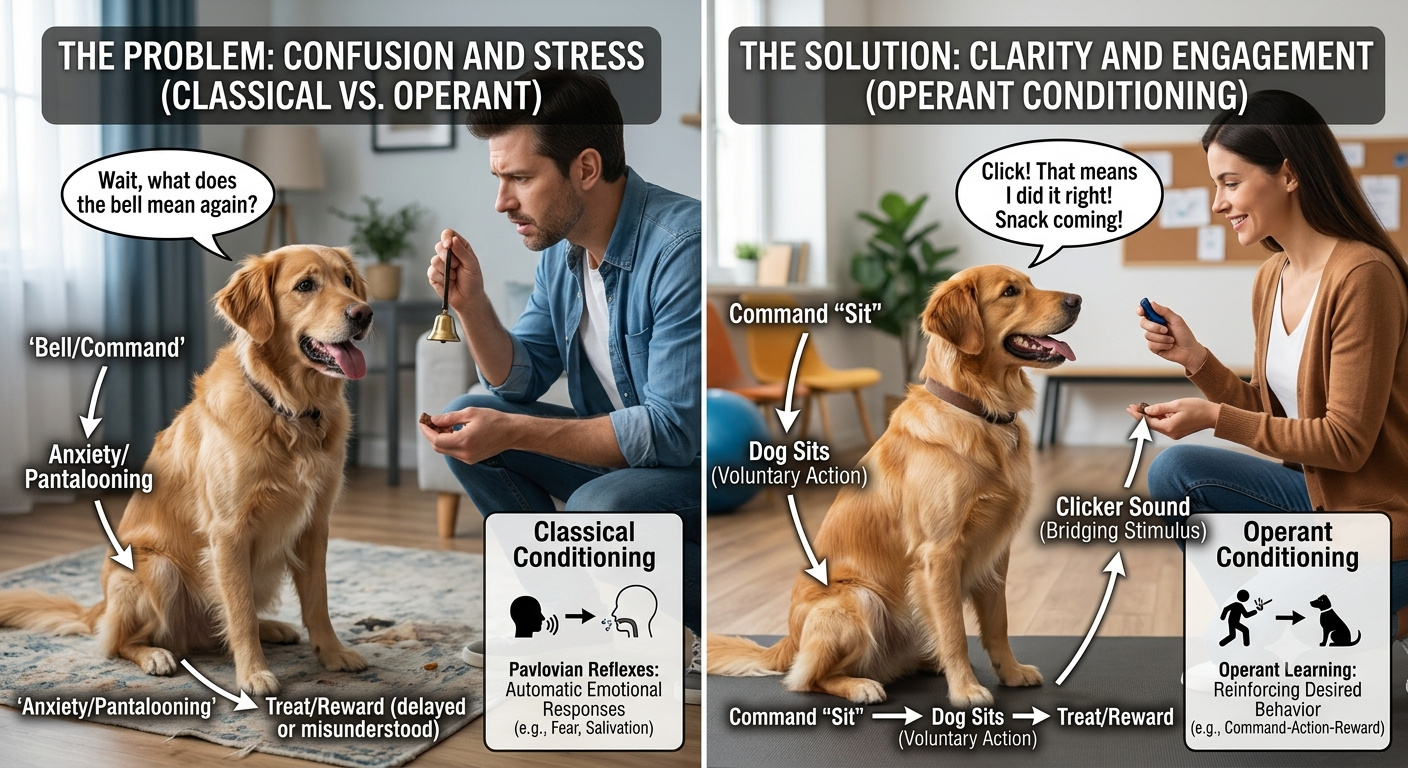
Classical vs Operant: Side-by-Side for Potty Training Key Differences
🔵 Classical Conditioning
- Automatic — your dog can’t control it
- Creates emotional associations
- Works through repetition and pairing
- Best for: cue words, leash associations, location triggers
- Example: “Go potty” said every trip → dog begins to squat when they hear the phrase
- Risk: negative emotions pair just as easily as positive ones
🟢 Operant Conditioning
- Conscious — your dog chooses behaviors based on outcomes
- Creates behavioral habits
- Works through immediate consequences
- Best for: teaching where to go, rewarding outdoor success
- Example: goes outside → gets treat → goes outside more often
- Risk: delayed rewards break the learning connection
How to Combine Both Methods for Fastest Potty Training Results
The most effective potty training doesn’t choose between classical and operant conditioning — it uses both deliberately and simultaneously. Here’s exactly how:
Step 1: Use Classical Conditioning to Create a Trigger
Choose one consistent cue word — “go potty,” “outside,” “bathroom” — and say it in the same calm tone every single time you take your dog to their outdoor spot. Over days, the word itself begins to trigger the urge to eliminate through classical association. This is exactly what Pavlov’s bell did — except you’re pairing your phrase with the act of going, not with food.
Step 2: Use Operant Conditioning to Reinforce the Location
The moment your dog finishes going in the designated outdoor spot, apply positive reinforcement within 3 seconds: treat + enthusiastic praise. This operant reward teaches your dog that the specific behavior of eliminating in that spot produces a desired outcome. Repeat this consistently and the behavior frequency increases naturally.
Step 3: Avoid Accidentally Pairing Negative Emotions
This is where most owners unknowingly sabotage their own classical conditioning. Every time you feel frustrated near an accident, your emotional state (body language, tone, tension) is being classically paired with the location of the accident and your dog’s experience of being near you. Keep your emotions completely neutral indoors and save all your enthusiasm for the outdoor successes.
🎬 Watch our video guide on how to apply conditioning principles to potty training step by step:
How to Potty Train Your Dog Quickly Using Conditioning Science
Speed in potty training comes from the density of correct learning experiences per day — not from training sessions that are longer or more intense. Here’s how to maximize learning density:
- 8–10 outdoor trips per day for young puppies — each one is a learning opportunity
- Reward every single outdoor success for the first two weeks — no exceptions
- Say the cue word every trip — even when you’re tired, even on weekends
- Zero emotional reaction indoors — accidents are cleaned silently, without any fuss
- Same spot every time — the familiar scent plus your cue word combines classical triggers for faster activation
How to Stop Your Dog from Peeing in the House Using Both Methods
Stopping indoor accidents permanently requires applying both conditioning types to remove the behavioral habit and replace it with a new one:
| Problem | Conditioning Type | Solution |
|---|---|---|
| Dog returns to same indoor spot | Classical | Enzymatic cleaner removes scent trigger; change spot’s association with food/toys |
| Dog doesn’t signal before going | Operant | Reward every time dog goes to door — even when you initiated the trip |
| Dog goes immediately after coming inside | Classical | Stay outside longer; pair “all done” phrase with going back in only after full elimination |
| Training stalls after initial progress | Operant | Rotate treat types; add jackpot rewards to re-activate dopamine response |
Indoor Potty Training for Small Dogs: Conditioning Works the Same Way
The conditioning principles are identical for indoor pad training — the only difference is the target location. Use the same cue word, the same immediate reward, and the same neutral emotional response, but direct everything toward the pad or grass tray instead of an outdoor spot.
Potty Training an 8-Month-Old Dog: Breaking Old Conditioning
An 8-month-old dog that hasn’t been properly trained has already formed classical and operant associations — they’re just the wrong ones. Indoor spots have become classically associated with “bathroom,” and eliminating wherever convenient has been operantly reinforced (it worked, so it continued).
Breaking these established patterns requires three parallel actions:
- Extinguish the indoor classical trigger — enzymatic cleaner on every previous accident spot, consistently
- Counter-condition the indoor spots — feed meals and play games near former accident areas to replace the “bathroom” association
- Build new operant habits from scratch — treat and praise every outdoor success as if it’s the first time, regardless of the dog’s age
Golden Retriever Potty Training: Why This Breed Responds So Well to Conditioning
Golden Retrievers are exceptional conditioning subjects — and understanding why helps you use both methods even more effectively with this breed.
Goldens were selectively bred for generations to respond to human cues, work in close coordination with handlers, and find human approval inherently rewarding. This means their classical conditioning (association-building) and operant conditioning (reward-seeking) are both operating at a high level from the start.
Frequently Asked Questions
The 7-Day Potty Training Program applies classical and operant conditioning principles in a clear daily plan — no theory, just the exact steps that work.
🎯 Get the Full 7-Day Program Now
✅ Instant access · All breeds · Puppies to adults