Does Your Dog Pee Inside After a Walk? Here’s the Ultimate Potty Training Solution
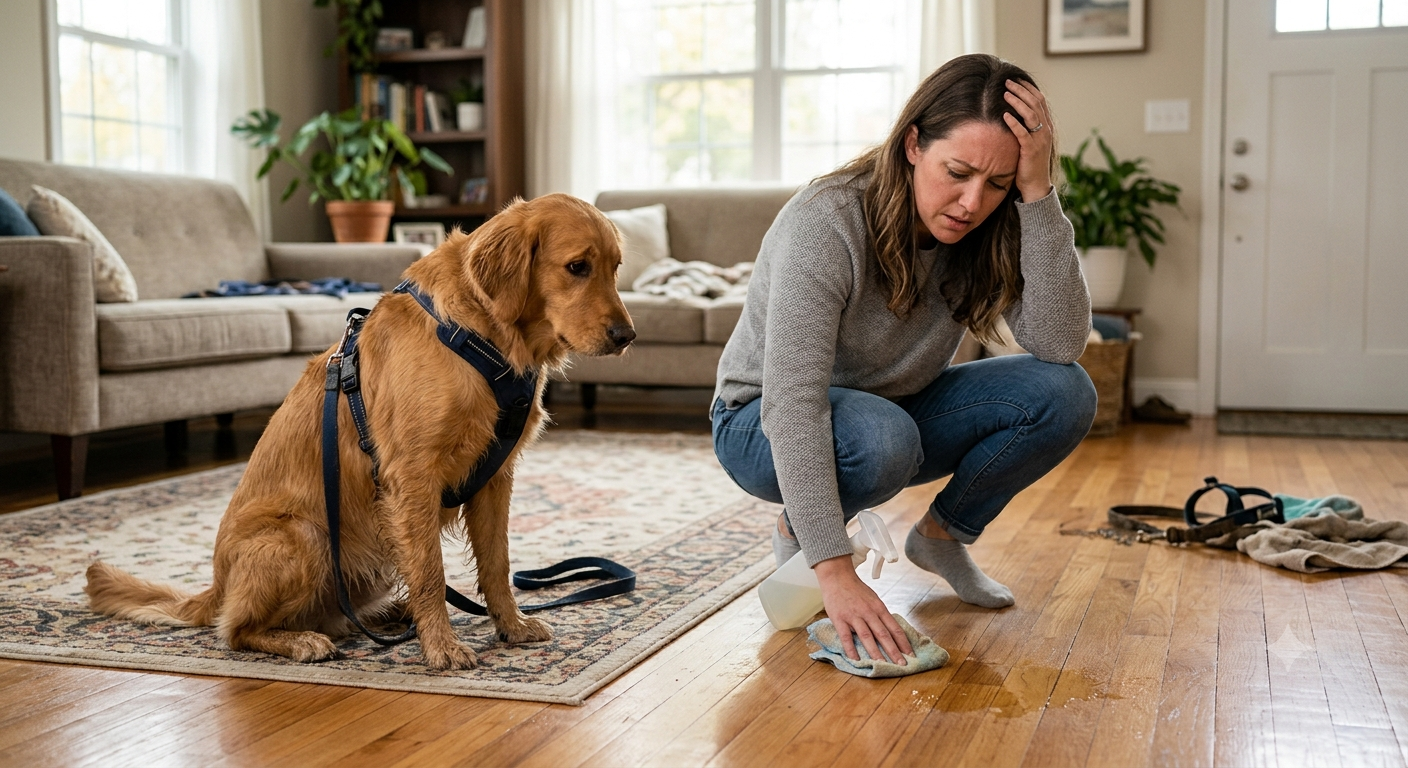
Daniel adopted a 5-month-old rescue mix named Benny and started potty training immediately. He walked Benny twice a day, each walk lasting 20–30 minutes. Benny would sniff constantly, sometimes stop, sometimes squat briefly — but never fully go during the walk. The moment they returned home and Daniel unclipped the leash, Benny would trot directly to the same corner of the living room and pee.
Daniel tried longer walks. He tried different routes. He tried waiting outside even longer before coming in. Nothing changed. Benny seemed physically incapable of going outside — and perfectly comfortable going the moment he was back inside.
A trainer identified two overlapping problems. First, Benny was too stimulated during walks to relax enough to eliminate — every smell, sound, and distraction kept his nervous system in alert mode. Second, the living room corner had an existing scent history from previous accidents that was drawing him back. The walk itself wasn’t a potty trip — it was exercise and exploration. The corner was the bathroom.
The trainer’s fix: stand still in one quiet outdoor spot for 5 minutes before and after the walk. Treat that stand-still period as the dedicated potty time — walk is separate. Clean the corner with enzymatic cleaner. Within four days, Benny was going in the dedicated outdoor spot every single time. The walk was never the potty break. It just looked like one.
Why Your Dog Pees Inside Right After a Walk: The 5 Real Causes
When a dog pees inside after a walk, it almost never means the training has failed. It means one or more of these specific, fixable conditions is present:
Dogs on walks are in explore mode — alert, sniffing, reacting to stimuli. This heightened nervous system state often prevents full physical relaxation, which is required for elimination. The moment they return home to a familiar, safe environment, the body finally relaxes and releases. This is not defiance — it’s physiology.
A walk covers different ground every time, which means no consistent scent trigger is building. A dog that has a fixed outdoor spot where they always go develops a classical association — the familiar scent of the spot triggers the urge to eliminate. Without that spot, the urge stays suppressed during the variable walk environment.
If your dog pees inside repeatedly — especially in the same spot — previous accidents cleaned with non-enzymatic products have left uric acid scent markers that your dog reads as “bathroom.” The walk doesn’t offer a competing scent trigger strong enough to override the indoor one.
Your dog may have urinated briefly during the walk — a quick squat you might have missed — but didn’t fully empty. The remaining urgency surfaces the moment they relax indoors. This is why the indoor accident often happens within 30–90 seconds of coming inside rather than 10–20 minutes later.
Without a consistent cue word used at a fixed outdoor spot, your dog has no verbal or environmental trigger that says “this is where I go.” The walk offers infinite exploration but no clear “go now” signal, so the body defers until the dog is in a familiar environment — which, if indoor scent markers exist, is the living room corner.
Our complete program covers the dedicated potty spot system, cue word conditioning, schedule, and reward strategy — everything you need to stop your dog from peeing inside after walks.
✅ Works for all breeds · All ages · Instant access
The Ultimate Solution: 6 Steps to Stop Your Dog Peeing Inside After Walks Complete Fix
These six steps address every cause simultaneously. Apply all of them together for the fastest results — fixing only one or two will slow the process significantly.
Before the walk, spend 5–10 minutes standing still at your designated outdoor potty spot. Do not walk, explore, or allow sniffing of other areas during this time. The walk comes after elimination — as a reward for going in the right place. This distinction alone resolves the problem for most dogs within 3–5 days.
Pick a specific, quiet area — a corner of your yard or a consistent section of sidewalk — and always take your dog there first. Over 7–14 days of consistent use, the familiar scent of the spot classically conditions your dog to eliminate there quickly and reliably. The spot becomes a trigger as powerful as the cue word itself.
Say “go potty” (or your chosen phrase) in a calm, clear tone every time you arrive at the spot. After 10–14 days of consistent pairing, the phrase begins to function as a conditioned trigger — your dog starts to associate the cue with the act of going and responds faster each time they hear it.
Most owners wait 2–3 minutes, conclude their dog doesn’t need to go, come back inside, and then discover they were wrong 60 seconds later. Set a timer for 5 minutes minimum at the potty spot. If nothing happens after 10 minutes, come inside, supervise closely, and try again in 20 minutes. Do not go on the walk until the potty trip is complete.
Within 3 seconds of your dog finishing at the outdoor spot: high-value treat plus genuine excited praise. This operant reward builds the neural association between going in the right place and great things happening. The walk itself then becomes an additional reward that follows the correct behavior — doubling the positive reinforcement loop.
Every indoor spot that hasn’t been cleaned with enzymatic cleaner is actively competing against your training by drawing your dog back. Clean every known and suspected spot thoroughly, allow 24 hours, and treat again. A UV blacklight will reveal spots you didn’t know existed. Remove all indoor scent triggers and the pull toward those locations disappears.
🎬 Watch our full video guide on why dogs pee inside after walks and the exact steps to fix it:
How to Stop Your Dog from Peeing in the House Permanently
Fixing the post-walk accident is one part of the complete solution. For permanent results — no indoor accidents, consistent outdoor signaling, full house training reliability — the broader system needs to be in place:
| Problem | Cause | Complete Fix |
|---|---|---|
| Pees inside right after walk | Distraction during walk prevents relaxation + no fixed potty spot | Separate potty trip from walk + fixed spot + cue word |
| Returns to same indoor spot | Scent history from improper cleaning | Enzymatic cleaner twice + UV blacklight audit |
| No signaling at the door | Cue word not conditioned + signals ignored | Consistent cue word + immediate response to every signal |
| Accidents when unsupervised | Too much indoor freedom too soon | Leash indoors or crate when not watched |
| Random accidents mid-day | Schedule gap or missed post-meal/drink trip | Add trigger-based trips to fixed schedule |
How to Potty Train Your Dog Quickly With the Walk-First Method
The potty-before-walk method is one of the fastest potty training techniques available because it uses the walk itself as a powerful reward. Dogs are highly motivated by walks — fresh smells, new environments, and physical freedom are among the most exciting things in a dog’s day. When the walk becomes the reward for going outside first, the motivation to eliminate at the designated spot increases dramatically.
- Potty spot first, every time — before any walk, any play, any exciting activity
- Treat + praise within 3 seconds of outdoor success
- Walk immediately after as a secondary reward — your dog connects eliminating outside with getting to go on the walk
- Post-walk potty stop — always return to the outdoor spot for 3–5 minutes after the walk ends before going inside
- Supervise or crate on arrival home if the post-walk potty stop produced nothing
Indoor Potty Training for Small Dogs: Walk-Related Accidents Are More Common
Small breed dogs on walks are bombarded by proportionally more overwhelming stimuli than large breeds — taller legs, more ground-level smells, and higher sensitivity to environmental noise. This makes the “too stimulated to go” problem especially common in small dogs. A Chihuahua or Maltese that seems completely unable to go outside may simply need a quieter, smaller dedicated spot rather than a full walk environment.
Potty Training an 8-Month-Old Dog: Breaking the Walk-Then-Inside Habit
An 8-month-old dog that has been peeing inside after walks for months has a firmly established two-part habit: walk for stimulation, come inside and use the bathroom. Breaking this requires making the outdoor potty spot more compelling than the indoor one through consistent conditioning — while simultaneously removing all indoor scent attractions.
Expect the habit to take 2–3 weeks to fully break in an older dog. The first 5–7 days are the hardest — maintain the potty-before-walk structure even when your dog seems confused or uncooperative. The habit breaks through repetition, not through individual forceful sessions.
Golden Retriever Potty Training and the Post-Walk Problem
Golden Retrievers are highly distractible on walks — their enthusiasm for smells, people, and other dogs keeps them in an almost constant state of stimulated excitement that prevents relaxation for elimination. This makes them one of the breeds most likely to come home and pee inside after even a long walk.
The fix works especially well for Goldens because of their high food motivation: a Golden that learns that standing still at the potty spot produces a piece of chicken will begin actively trying to go at that spot within just a few days. Their desire for the reward accelerates the conditioning significantly faster than in many other breeds.
Frequently Asked Questions
The 7-Day Potty Training Program includes the potty-before-walk protocol, fixed spot conditioning, cue word training, and everything else you need to stop post-walk indoor accidents permanently.
🎯 Get the Full 7-Day Program Now
✅ Instant access · All breeds · Puppies to adults