My Puppy Kept Peeing Inside for Weeks — One Change Fixed It in 3 Days
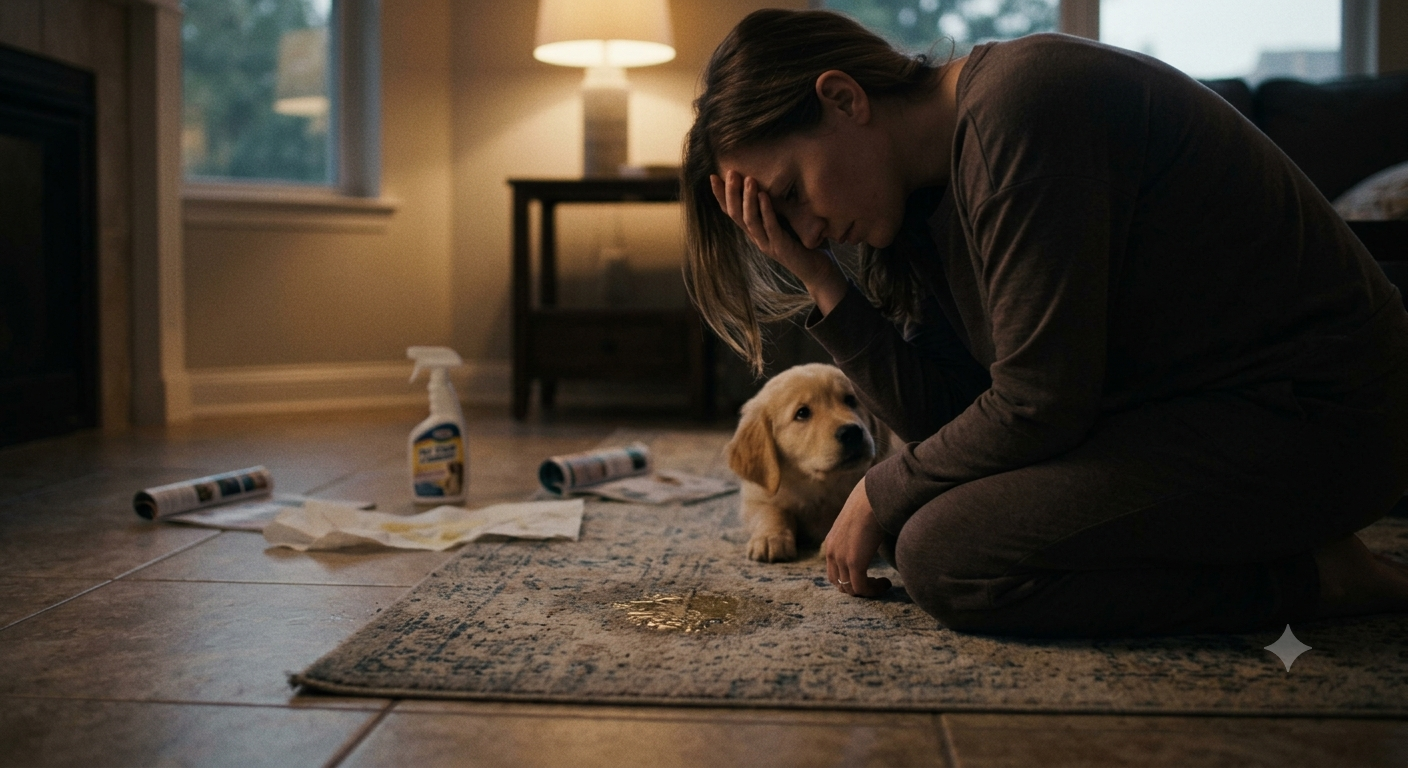
I brought home Luna, my 10-week-old Golden Retriever, in early spring. I’d done my research. I had a schedule. I took her out every hour, after every meal, after every nap. I gave her a treat within seconds of going outside. She had a correctly sized crate. On paper, I was doing everything right.
But Luna kept peeing inside. Specifically, she kept returning to the same two spots — the corner behind the couch and the edge of the hallway rug. I cleaned them every time. With regular floor cleaner, then with a specialized “odor eliminator” spray I bought at the pet store. The spots smelled clean to me. Luna clearly disagreed.
Week three, I mentioned this to a trainer friend. She asked one question: “Are you using an enzymatic cleaner?” I said I was using an odor neutralizer. She stopped me there. “That’s your problem. Odor neutralizer masks the smell to you. Enzymatic cleaner breaks down the urine molecules. Your dog is going back to those spots because she can still smell them — perfectly clearly.”
I ordered an enzymatic cleaner that night. Cleaned both spots twice, 24 hours apart. On day three after the second treatment: zero accidents. Luna went straight to the door when she needed to go. Six weeks of frustration. One product switch. Three days to results.
The One Change That Fixed Weeks of Indoor Puppy Accidents
The change wasn’t a new training method. It wasn’t a different schedule or a better treat. It was switching from a standard odor-masking spray to a genuine enzymatic cleaner — and applying it correctly.
The real reason your puppy keeps peeing inside:
Every time your puppy pees inside and you clean it with a non-enzymatic product, you remove the stain and the human-detectable smell — but leave behind uric acid crystals that your dog’s nose reads as a clear signal: “This is a bathroom. Come back here.” Standard cleaners cannot break down these molecules. Enzymatic cleaners can.
The 7-Day Potty Training Program covers cleaning strategy, schedule, reward timing, and every other variable that causes puppy peeing inside to persist — all in one daily plan.
✅ Works for all breeds · Puppies and adult dogs · Instant access
Why Standard Cleaners Keep Your Puppy Peeing in the Same Spot
This is the part that most puppy potty training guides skip entirely — and it’s why so many owners do everything else correctly and still can’t stop their puppy from peeing inside.
| Cleaner Type | What It Removes | What It Leaves Behind | Effect on Training |
|---|---|---|---|
| Regular floor cleaner | Surface stain, some ammonia | Uric acid crystals, pheromones | 🔴 Dog returns to spot reliably |
| Odor neutralizer spray | Ammonia smell (to humans) | Uric acid crystals still active | 🔴 Dog still detects spot clearly |
| Bleach-based cleaner | Bacteria, surface stain | Uric acid + ammonia smell amplified | 🔴 Can make the problem worse |
| Steam mop | Surface bacteria | Uric acid heat-bonded into fibers | 🔴 Permanently embeds the scent |
| Enzymatic cleaner | All urine components including uric acid | Nothing — complete molecular breakdown | 🟢 Dog loses interest in spot |
How to Use Enzymatic Cleaner Correctly to Stop Puppy Peeing Inside Step-by-Step
Enzymatic cleaner only works when applied correctly. Most people use too little, don’t let it sit long enough, or apply it only once. Here’s the exact method:
Use paper towels to absorb as much liquid as possible before applying any cleaner. Scrubbing spreads the urine deeper into carpet fibers and padding, making full elimination harder. Blot from the outside of the stain toward the center.
The cleaner must penetrate as deep as the urine did. For carpet, this often means soaking through to the padding. Apply enough to fully saturate the affected area. A light spray on the surface won’t reach the uric acid crystals underneath.
The enzymatic action requires contact time. The enzymes need to be in contact with the uric acid molecules long enough to fully digest them. Don’t blot or wipe during this period — you’ll interrupt the process.
One application often isn’t enough for set-in stains or accidents that soaked deep into flooring. A second treatment 24 hours later ensures complete breakdown of all remaining uric acid crystals — this is the step most owners skip, and it’s the most important one for older stains.
Don’t let your puppy return to a damp spot — they may re-mark before the enzymatic action is complete. Place furniture, a laundry basket, or a pet gate over the area until fully dry.
Dried urine is invisible to the naked eye but glows clearly under UV light. Check every corner, under every piece of furniture, and along every wall edge. Old accidents you’ve never found are pulling your puppy back to those locations. Find them all and treat them all.
But the Cleaner Alone Isn’t Enough: The Complete System to Stop Indoor Accidents
Switching to enzymatic cleaner was the breakthrough for Luna — but it only worked because the rest of the puppy potty training structure was already in place. The cleaner removes the attraction to old spots; the training builds the habit to go in the right one. Both are required.
| Element | What It Does | Without It |
|---|---|---|
| Enzymatic cleaner | Removes scent triggers pulling puppy back indoors | Puppy keeps returning to old spots regardless of training |
| Consistent potty schedule | Provides regular outdoor opportunities before urgency builds | Accidents happen in the gaps between trips |
| Immediate reward outdoors | Builds dopamine association with going in the right place | Outdoor success has no more value than indoor |
| Cue word | Classical trigger that accelerates outdoor elimination | Every trip requires waiting for natural urge |
| Supervision or crate | Prevents unsupervised indoor accidents from reinforcing | Wrong habit continues building in parallel with training |
How to Potty Train Your Puppy Quickly Once the Spots Are Cleaned
With all previous accident spots treated with enzymatic cleaner, your puppy’s indoor bathroom map is effectively erased. Now the schedule and rewards can actually work without competing against scent signals. Here is the daily structure that produces the fastest results:
- Out immediately after waking — no delay, every morning, before anything else
- Out 15 minutes after every meal — the gastrocolic reflex is predictable; don’t miss this window
- Out after every play session — physical activity stimulates the bladder reliably
- Out every 2 hours for puppies under 4 months during the day
- High-value treat + genuine praise within 3 seconds of finishing outside — every single time
- Same designated outdoor spot — familiar scent accelerates the urge
- Leash or crate when unsupervised — zero unsupervised indoor roaming during training
Indoor Potty Training for Small Dogs: The Cleaner Problem Is Even More Critical
Small dogs produce smaller accidents — which means their puddles soak into floors and dry completely without leaving an obvious visible stain. This makes the hidden-accident problem dramatically worse for small breed owners: there can be dozens of undetected, fully dried accident spots pulling a small dog back to those locations, with the owner having no idea they exist.
If you have a small dog that keeps peeing inside despite consistent puppy potty training, a UV blacklight audit of your entire home is the single most important action to take before continuing any other training adjustments. Find every hidden spot. Treat every one with enzymatic cleaner. The difference is often immediate and dramatic.
Potty Training an 8-Month-Old Dog: Breaking the Old Spot Habit
An 8-month-old dog that has been peeing inside for months has a well-established scent map of indoor bathroom locations. Every spot that was ever used and improperly cleaned is still drawing them back. The enzymatic cleaning audit is even more important for older dogs — the scent history is deeper, more extensive, and harder to fully eliminate.
Golden Retriever Potty Training and the Scent Problem
Golden Retrievers have an exceptionally powerful sense of smell — even for a dog. A spot that you’ve cleaned with a standard odor neutralizer and that smells completely clean to you may still carry a strong, clear urine signal to a Golden. This is why Golden owners sometimes find that puppies return to spots persistently even when training seems solid in every other way.
Frequently Asked Questions
The 7-Day Potty Training Program covers cleaning strategy, schedule timing, reward system, and supervision — everything you need to stop puppy peeing inside and build the outdoor habit that lasts.
🎯 Get the Full 7-Day Program Now
✅ Instant access · All breeds · Puppies to adults