Why Punishing Your Dog for Potty Accidents Makes Training Worse
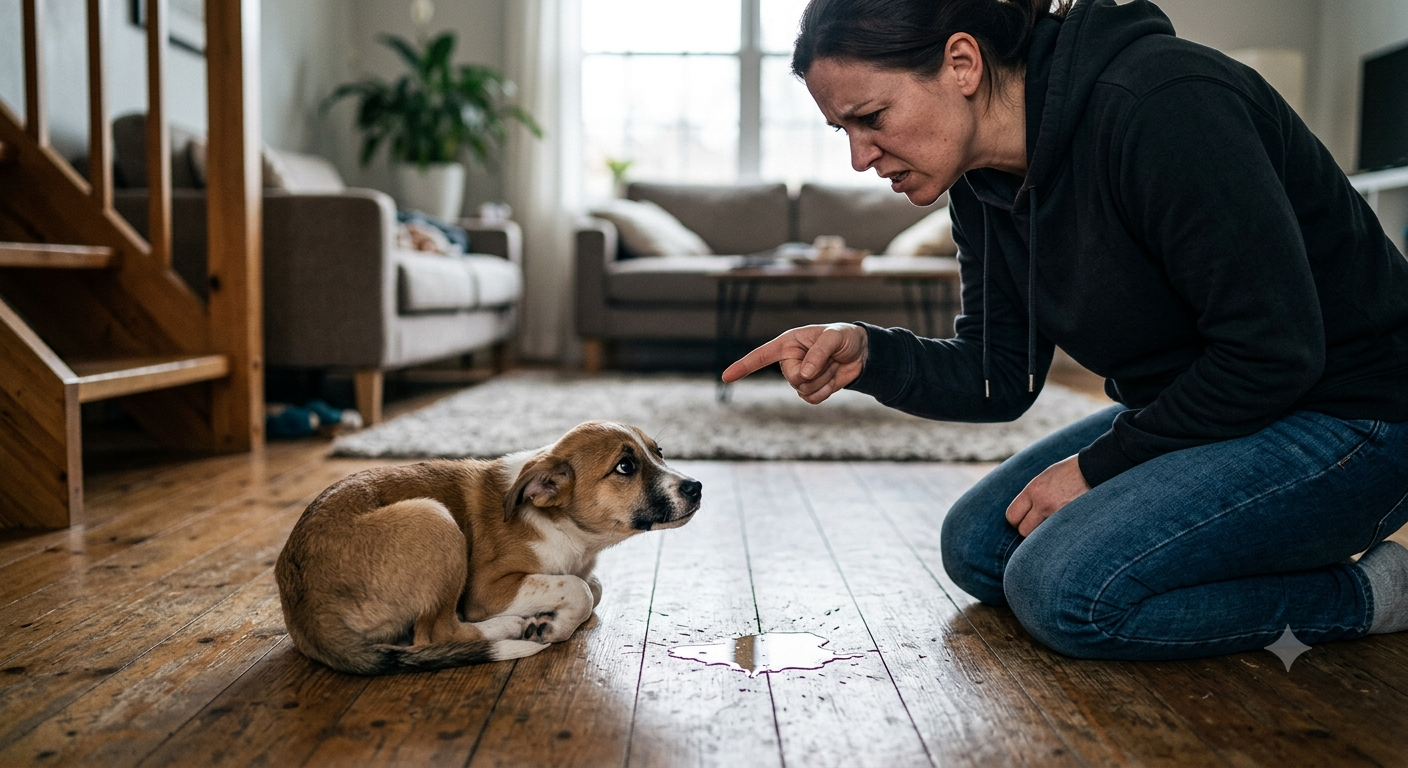
Mark had been training his 4-month-old Labrador, Rex, for two weeks with decent results. Then treats stopped working — Rex would take them half-heartedly or ignore them completely. Frustrated, Mark switched tactics. When Rex had an accident, he raised his voice, pointed at the mess, and made Rex sit nearby while he cleaned it up.
Within three days, something strange happened. Rex started hiding to pee. Behind the sofa. In the corner of the bedroom. In spots Mark couldn’t easily see. Rex also started cowering whenever Mark came near with the cleaning spray — even when no accident had occurred.
Rex hadn’t learned not to pee inside. He’d learned to hide it from Mark. The punishment hadn’t stopped the behavior — it had just made it invisible. It took Mark four more weeks to undo the anxiety Rex had developed, starting completely from scratch with positive methods.
The Real Reason Punishment Doesn’t Work for Potty Training
Punishment feels like it should work because it works for humans. We connect consequences to actions clearly, even when they’re delayed. Dogs don’t work this way — and this is the fundamental mismatch that makes punishment not just ineffective, but actively damaging.
What Your Dog Actually Learns from Punishment
| What You Think They’re Learning | What They’re Actually Learning |
|---|---|
| “Don’t pee inside” | “Peeing near this human leads to scary things” |
| “Go outside instead” | “Hide when I need to go” |
| “I made a mistake” | “This human is unpredictable and scary sometimes” |
| “I should signal before going” | “Don’t signal — just disappear to a quiet corner” |
| “Accidents are bad” | “Getting caught near an accident is bad” |
Our complete program is built on science-backed positive methods that actually work — no punishment, no setbacks, no hidden accidents.
✅ Gentle methods · All breeds · Instant access
The Neuroscience of Why Dogs Learn Differently
Understanding how a dog’s brain processes consequences is what makes everything else click. Dogs are not small humans with shorter attention spans — they process cause and effect in a fundamentally different way.
When a dog has an accident and you respond with punishment minutes later, here’s what happens neurologically: your dog’s brain is already fully in the present moment. The neural pathway between “I peed five minutes ago” and “this human is now angry” simply does not form. What does form is the association between your current emotional state and your dog’s current experience — which is anxiety, not learning.
What to Do Instead: The Positive Replacement Method Step-by-Step
Replacing punishment with an effective positive approach isn’t about being soft — it’s about being smart. Here’s the exact framework that works faster and produces more lasting results than any form of punishment.
If you catch your dog mid-accident, make a calm neutral sound (“ah-ah”) to interrupt. Immediately pick them up or guide them outside to finish. Reward if they complete outside. This is the only in-the-moment response that actually teaches anything.
If you find the accident after it happened, punishment is completely useless. Clean thoroughly with enzymatic cleaner and move on. Direct your energy toward preventing the next one, not reacting to the last one.
Every accident that happens unsupervised is a training failure — not a character failure. Keep your dog in the same room as you, use a crate when you can’t watch them, and expand freedom only after consistent success.
Within 3 seconds of your dog finishing outside: treat + genuine excited praise. Make the outdoor bathroom feel like the most rewarding thing in their world. This positive association builds faster than any punishment ever could.
Most indoor accidents happen because the schedule has gaps, not because the dog is being defiant. When accidents increase, review your timing — did you miss a post-meal trip? Was the interval too long? Fix the system, not the dog.
Punishment vs. Positive Training: Side-by-Side Comparison
❌ Punishment Approach
- Yelling at the dog near the accident
- Rubbing their nose in the mess
- Sending them away after discovery
- Withholding affection after accidents
- Physical corrections or stern taps
- Long verbal lectures or shaming
✅ Positive Approach
- Calm interruption if caught mid-act
- Silent, thorough enzymatic cleaning
- Immediate reward when they go outside
- Tightened supervision after accidents
- Schedule review and adjustment
- Consistent routine without emotional reactions
How to Stop Your Dog from Peeing in the House Without Punishment
Stopping indoor accidents permanently requires removing the opportunity for accidents to happen — not adding consequences after they do. Here’s how to restructure your approach:
- Reduce indoor freedom — the more space your dog has unsupervised, the more opportunities for accidents. Start small and expand as trust builds.
- Fix the schedule — most accidents happen in predictable windows (after meals, after naps, after play). Cover every trigger without exception.
- Use enzymatic cleaner every time — scent residue from previous accidents attracts dogs back to the same spot. Remove it completely or you’re fighting an uphill battle.
- Watch for signals — sniffing, circling, sudden restlessness. When you see them, react immediately. Every signal you respond to replaces a potential punishment moment.
Indoor Potty Training for Small Dogs: Why Punishment Hits Harder
Small breeds are often more emotionally sensitive than larger dogs — meaning the negative impact of punishment is frequently more pronounced. A Chihuahua or Maltese that has been punished for accidents may develop generalized anxiety that affects their behavior far beyond just potty training.
For small dogs especially, the positive replacement method isn’t just more effective — it’s genuinely more important. Their smaller bladders mean more frequent accidents in early training, which means more opportunities for punishment to occur. Removing punishment entirely from the equation and replacing it with structure and rewards is the only approach that works sustainably for small breeds.
Potty Training an 8-Month-Old Dog: Breaking Punishment Habits
If you’ve been using punishment with an older puppy and you’re now reading this, the good news is: the damage is reversible. It takes time, but dogs are remarkably resilient and respond quickly when the emotional environment improves.
- Stop all punishment immediately — even mild reactions like sighing heavily or stiffening your body near accidents. Your dog is reading your emotional state, not your intentions.
- Rebuild trust with neutral interactions — spend a few days simply being calm, predictable, and positive regardless of what happens with accidents.
- Restart training with pure positive reinforcement — treat and praise every outdoor success as if it’s the first time. Over-reward for the first week to rebuild motivation.
- Watch for anxiety signals — hiding to eliminate, cowering near messes, refusing to go outside. These indicate punishment damage that needs active recovery before training can resume effectively.
Golden Retriever Potty Training: A Breed Built for Positive Methods
Golden Retrievers are one of the most punishment-sensitive breeds in existence. Their deep emotional bond with their owners means that any negative response from you — raised voice, stern expression, physical correction — registers as a significant emotional event that can affect their behavior for days.
Conversely, Goldens respond to positive reinforcement faster and more enthusiastically than almost any other breed. A Golden that’s being trained with treats, praise, and play will typically be fully reliable within 3–4 weeks. The same dog trained with punishment often takes twice as long — and carries lingering anxiety that complicates other areas of training.
Frequently Asked Questions
The 7-Day Potty Training Program gives you the exact positive method — schedule, rewards, supervision — that gets real results without punishment, setbacks, or hidden accidents.
🎯 Get the Full 7-Day Program Now
✅ Science-backed · All breeds · Puppies to adults